I remember when the hyperscalers weren't the defacto standard for distribution over the internet (I'm including PaaS, which are mostly wrappers for hyperscalers, in the same bucket). To deploy a piece of code you needed to understand Linux, the networking stack, the hardware and the software you were deploying plus some ancilary things like NGINX for proxying and the database technology you were using - buying a machine was never enough. Container workloads weren't really a thing until cgroups in 2006 and LXC a couple of years later, and even then the tools that made packaging your application easy wouldn't come until 2015 (e.g. Docker). In that span, AWS came and ate everyone's lunch and the cloud became the place to deploy rather than bare metal, which was expensive and required the aforementioned expertise. From there, Kubernetes dropped and container workloads became the default way to run software, regardless of whether you were managing the container or paying someone else to.
But the cloud isn't magic and Kubernetes, while easier to run than ever before, is a slab of software designed to run the largest workloads on the planet.
Now we have agents that understand the core concepts that were previously the expensive part of running on bare metal servers: network topology, RAID, sockets, firewalls, SIMD, memory pages, all of it. Compute density has ballooned in the last few generations as well, flipping the economics enough to reconsider the hyperscalers. And now that agents are coming into their own, the workloads are starting to change: the first few years of agentic coding, everyone built with traditional SaaS architectures - multi-tenent, integrations everywhere, walled gardens, and a dedicated UI. Now software is getting smaller. Not the code base per se, but the consumer base for any given project is much smaller - a team, an engineer, a family or even just another agent consuming the software.
The rise of cloud and container orchestration created a valley. On one side, PaaS that abstract the management away. On the other, Kubernetes and complexity. Going off the beaten track on a PaaS is painful. Supporting Kubernetes in production is overkill for most software and especially small software. The valley is populated with open source tooling and the operator has the burden of putting it all together.
Heyo Web Services
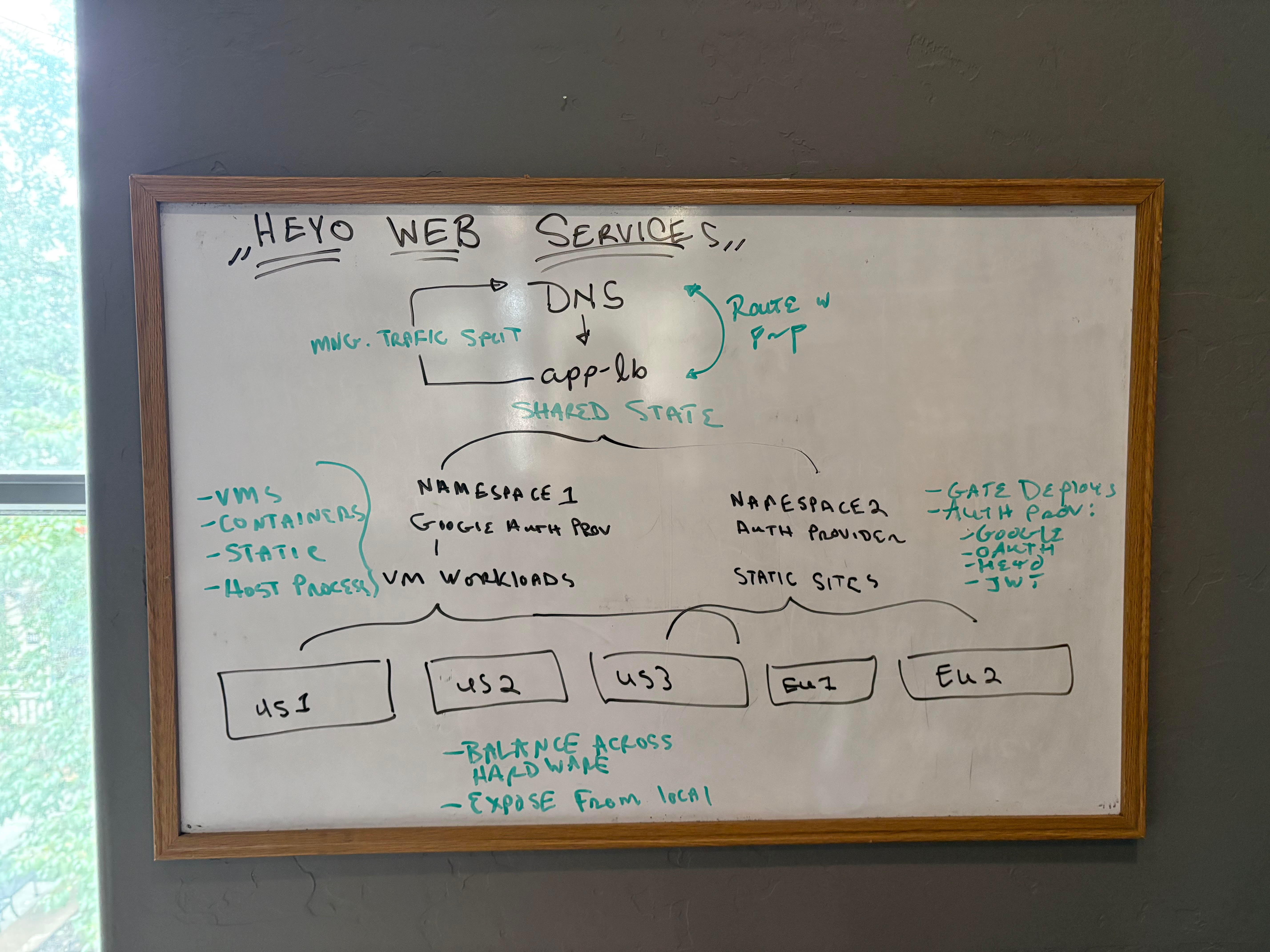
Today Heyo Computer announces the Heyo Web Services project. A stack of software meant to give the operator the power to build their own cloud and run it on their own metal. HWS is Kubernetes-shaped, so all agents already understand it. It builds on top of our VM tooling to run Firecracker and KVM workloads using customized VMs that you create with a Dockerfile. It combines Pingora, Cloudflare's library for proxying, with a control plane and a SIEM for exposing services, managing workloads and doing so securely. It ships with auth providers so you can plug in the Google client you already use, a JWT provider or use us. It ships with MCP so you can build on it from your agent instead of our closed source app.
Run many small apps. Run serverless databases. Run agent sandboxes. Run apps your agent created. Run LLMs.
Run from local desktops. Run from rented servers. Run from our bare metal.
Run your own agentic cloud.